Renewable heat from Wales's flooded coal workings.
Flooded workings beneath the Welsh coalfield offer a source of renewable heat. At Lindsay, water in the treatment lagoon is around 14–15°C. Wales’s first commercial mine-water heat scheme was developed by the Mining Remediation Authority in partnership with Thermal Earth, with Innovate UK funding, and has heated our warehouse and offices since March 2025.
A mining legacy becomes a heat source.
When the collieries closed, the workings flooded — and the earth has kept that water at a steady temperature ever since. For buildings near former mining areas, it is a heat source that was already paid for.

Stable in every season
Mine-water temperatures vary by site. At Lindsay, the treatment lagoon is around 14–15°C, providing the heat pump with a source that varies less than outdoor air.

Often already at the surface
Mine water in former coalfields is frequently pumped and treated anyway — at the Lindsay treatment scheme, around 25 litres a second pass through before discharge. Heat recovery rides on infrastructure that already exists.

Scales with the scheme
The same principle can serve a single building or a district network. Gateshead’s mine-water heat network has supplied homes and businesses since March 2023.
From flooded working to warm building, in four steps.
The mine water itself never enters the heating system — a heat exchanger passes its warmth to a sealed circuit, and a heat pump lifts the temperature the rest of the way.
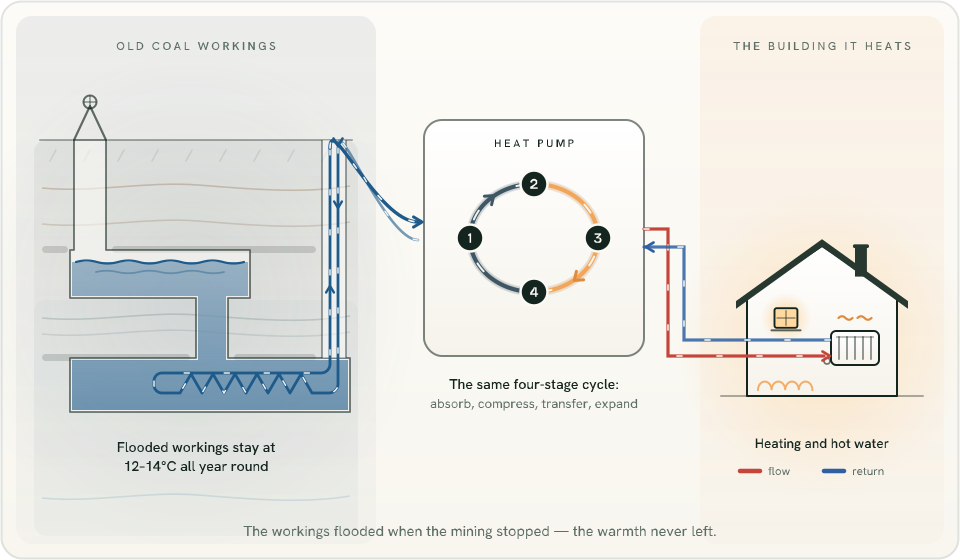
Warmth gathers underground
Flooded workings are warmed by the earth's stable subsurface temperature. At Lindsay, water rises from the old workings at up to 20°C.
A heat exchanger captures it
Open loop — mine water pumped through an exchanger at the surface — or closed loop, a sealed exchanger submerged in the water itself.
A heat pump lifts it
The compressor raises the captured warmth to a typical 45–55°C — ready for space heating and hot water.
The water carries on
The cooled mine water returns to be naturally re-warmed underground — or continues through treatment to discharge, exactly as it did before.
Open loop or closed loop — the site decides.
Both approaches deliver the same heat to the heat pump. Which one fits depends on water volume, quality and consenting — we assess that before recommending either.
Open loop
Mine water is pumped to the surface, passed through a heat exchanger, then returned to the mine or discharged to a watercourse.
- Higher heat-extraction rates — best suited to large schemes
- Typically needs an abstraction licence from Natural Resources Wales
- Water quality may call for treatment in the loop
Closed loop
A sealed heat exchanger sits submerged in the mine water, and clean fluid circulates between it and the heat pump. It is the approach we chose at Lindsay.
- No water abstraction — generally simpler consenting
- Lower maintenance, with the mine water fully separated
- Well suited to smaller and mid-scale installations
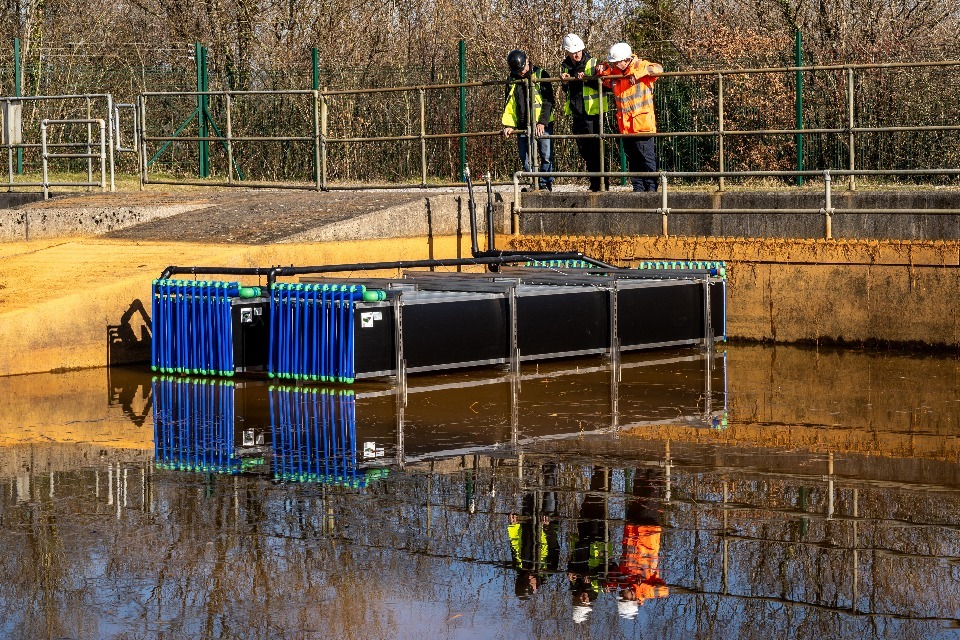
The Lindsay scheme: proof, on our own doorstep.
Developed near Ammanford by the Mining Remediation Authority in partnership with Thermal Earth, funded by Innovate UK following Welsh Government-commissioned mapping of mine-water heat opportunities — running since March 2025.
- Submerged heat exchangers
Sealed exchangers sit in the treatment lagoon, where the mine water holds a stable 14–15°C.
- MasterTherm AquaMaster 45 IP
One heat pump warms our industrial warehouse and offices at Capel Hendre — the facility that came off LPG to prove the concept.
- 17.5 tonnes of CO₂ a year
The projected annual carbon saving from this first installation alone.
- Built to scale
The same lagoon could heat up to ten family homes — and the approach has the potential to serve hundreds of households.
If you're near a former mining area, this is worth a conversation.
Wales's coalfield runs under towns, estates and industrial land. Proximity to flooded workings is the starting question — feasibility is ours to answer.

Local authorities & public estates
Schools, leisure centres and civic buildings across former coalfield areas — with a heat source aligned to the Heat Strategy for Wales.
Explore commercial systems
Housing developers
District and networked heating for new homes above old workings — mine water is a natural fit for shared-loop thinking.
Explore housing developments
Commercial & industrial sites
Warehouses, factories and offices near former mines — the Lindsay scheme heats exactly this kind of building today.
Ask about your siteMine-water heat, answered.
Part of our recovery discipline
Mine water is the signature — the wider capability recovers waste heat from processes, cooling and data centres.
Explore heat recoveryThe same networked thinking
Shared ground loops bring one ambient source to many homes — the design discipline behind district-scale mine-water schemes.
Explore shared ground loopsBuilt near old workings? Find out what's beneath you.
Whether you’re a local authority, a housing developer or a commercial property owner near a former mining area, we can assess feasibility for your site, drawing on the Lindsay scheme developed with the Mining Remediation Authority.