Store your solar. Use it when it matters.
Solar panels generate in the day; homes use most power in the evening. A battery closes that gap — storing your own electricity so your lights, appliances and heat pump can run on it after dark.
Keep more of the electricity you generate.
Without storage, surplus solar exports to the grid. With it, that surplus becomes your evening's electricity — how much that's worth depends on your tariff and how you use power, and we'll be straight with you about whether it stacks up.
Solar after sunset
Store what your panels generate in the day and draw on it in the evening — the hours when most homes use the most electricity and grid prices are at their highest.
Load shifting on smart tariffs
On a time-of-use tariff, a battery can also charge from the grid when electricity is cheap and supply your home when prices rise — useful even on days when the sun doesn't cooperate.
Evening heating on stored power
A heat pump runs on electricity, so a charged battery keeps it running on your own stored solar after dark — the evening half of the solar-plus-heat-pump story.
0% VAT until March 2027
Residential battery storage installations are currently zero-rated for VAT until 31 March 2027 — the quote you receive is the price you pay.
Generate, store, use — and export what's left.
Generate or import
Your panels generate in the day — or the battery charges from the grid on a cheap overnight rate.
Store the surplus
Excess energy charges the battery instead of exporting straight to the grid.
Use it when it matters
Your home draws on stored power in the evening and at peak rates, before importing anything.
Export what's left
Anything still spare exports and earns under the Smart Export Guarantee.
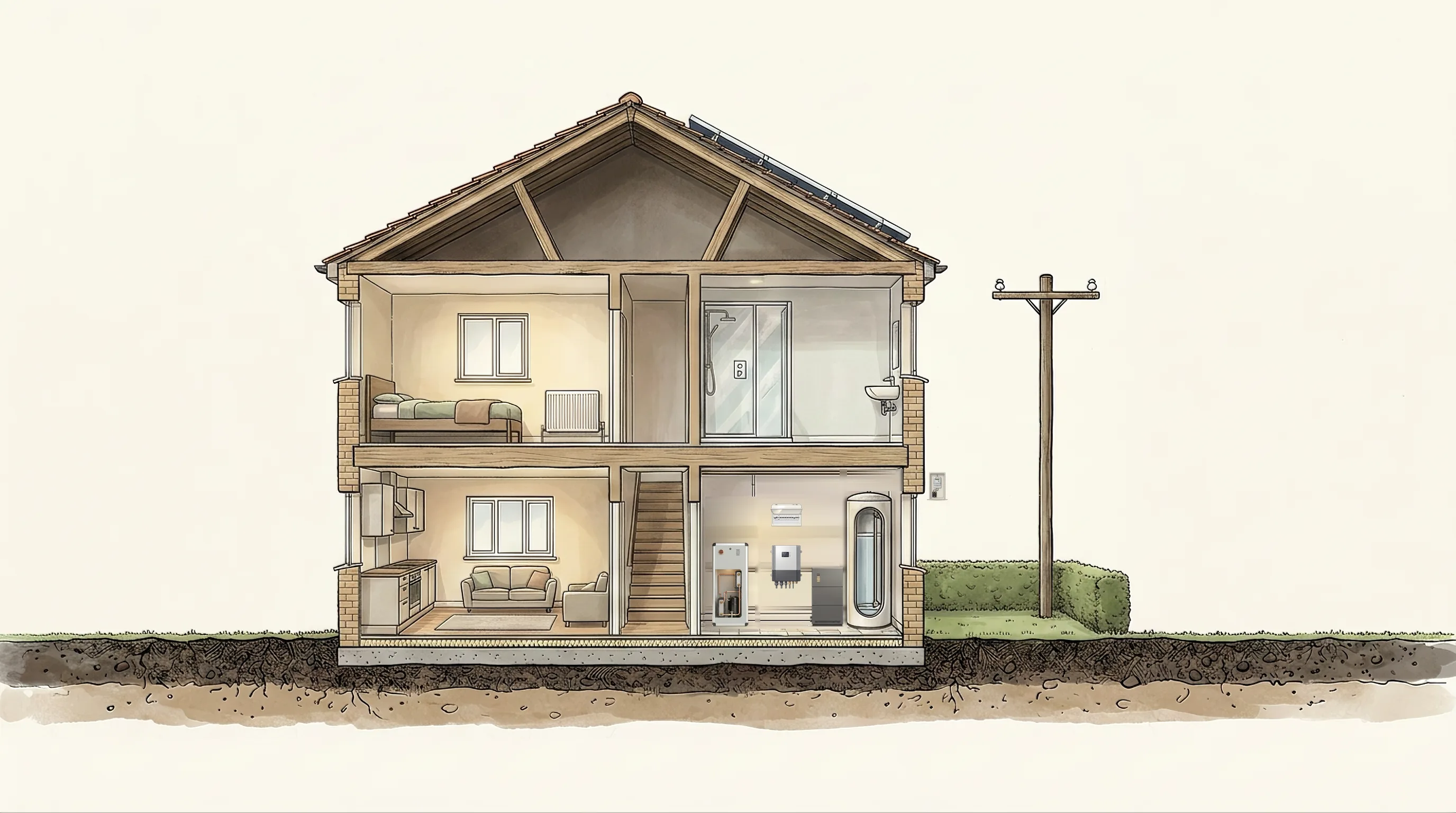
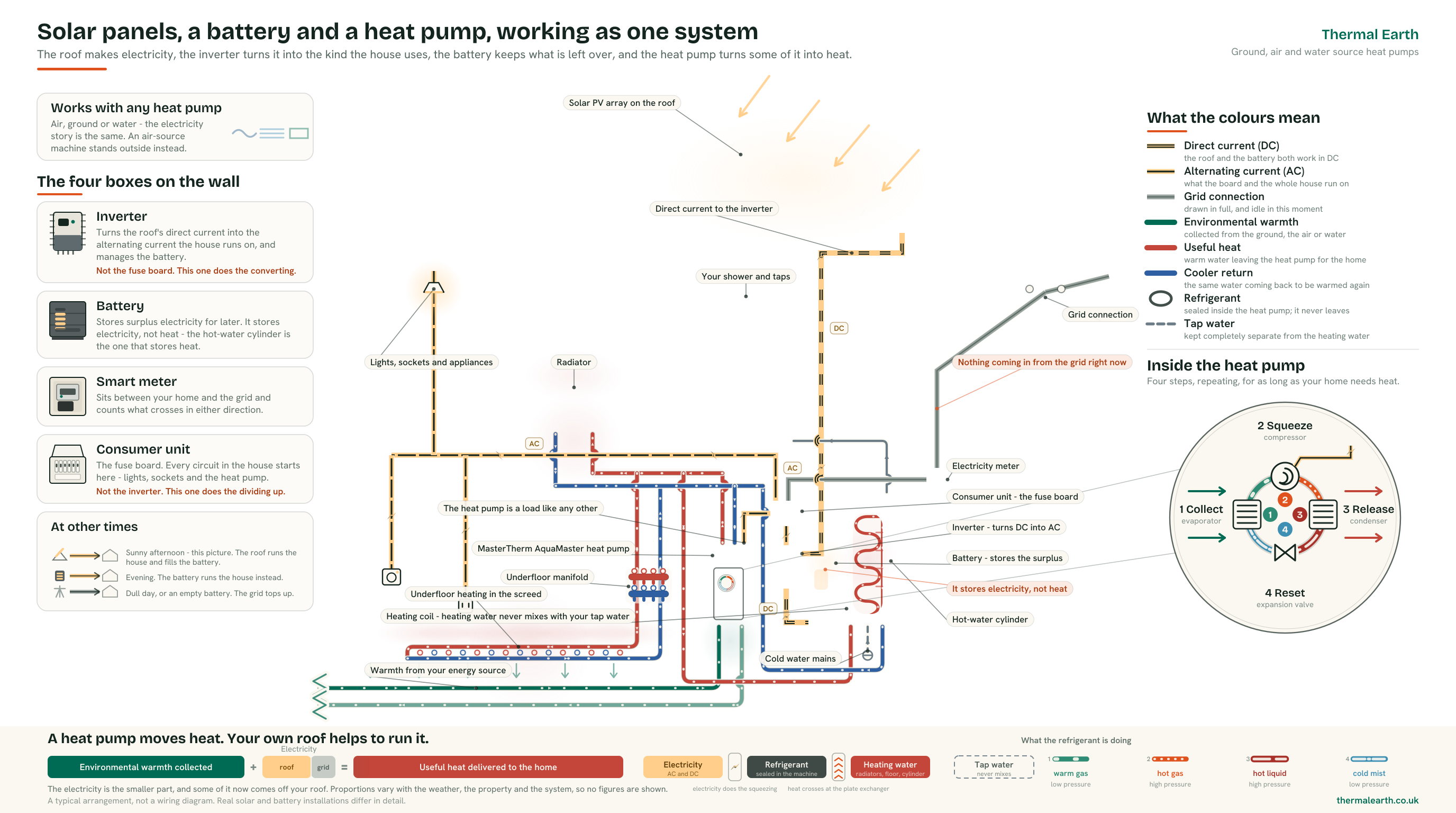
Scroll the picture sideways to see all of it. Every label is written out below.
Solar panels, a battery and a heat pump, working as one system
What is in the picture
- Environmental warmth collected from the ground, air or water Warmth from your energy source
- Heating water: warm out to the home, cooler back Hot-water cylinder; MasterTherm AquaMaster heat pump; Heating coil - heating water never mixes with your tap water; Underfloor heating in the screed; Underfloor manifold; Radiator
- Tap water, kept completely separate from the heating water Your shower and taps; Cold water mains
- The grid connection, drawn but not running at this moment Electricity meter; Grid connection
- Alternating current from the inverter to the board and the house Consumer unit - the fuse board; Lights, sockets and appliances; The heat pump is a load like any other
- Direct current from the roof to the inverter and the battery Solar PV array on the roof; Direct current to the inverter; Inverter - turns DC into AC; Battery - stores the surplus
- Refrigerant sealed inside the heat pump
The four steps inside the heat pump
- 1 Collect evaporator Environmental energy warms the refrigerant until it boils. It leaves as a warm gas at low pressure.
- 2 Squeeze compressor Electricity drives the compressor, squeezing that gas into a much smaller space. It leaves hot and at high pressure.
- 3 Release condenser The hot gas hands its heat to your heating water and condenses. It leaves as a hot liquid, still at high pressure.
- 4 Reset expansion valve A valve drops the pressure and the liquid flashes cold. It leaves as a cold mist, ready to collect more.
Solar, storage and your heat pump — designed as one.
Generate with solar PV, store the surplus, and run your heating on it in the evening. When the three are designed together, each part is sized around the others instead of bolted on afterwards.
Already have solar? Batteries can be retrofitted to most existing systems — we'll assess your current inverter and recommend either AC-coupled storage or a hybrid-inverter upgrade, whichever suits your setup.
There's also a thermal alternative: instead of storing electricity, a thermal store holds heat for your hot water. If hot water is the main goal, it can be the more cost-effective route — we'll advise which fits your home.
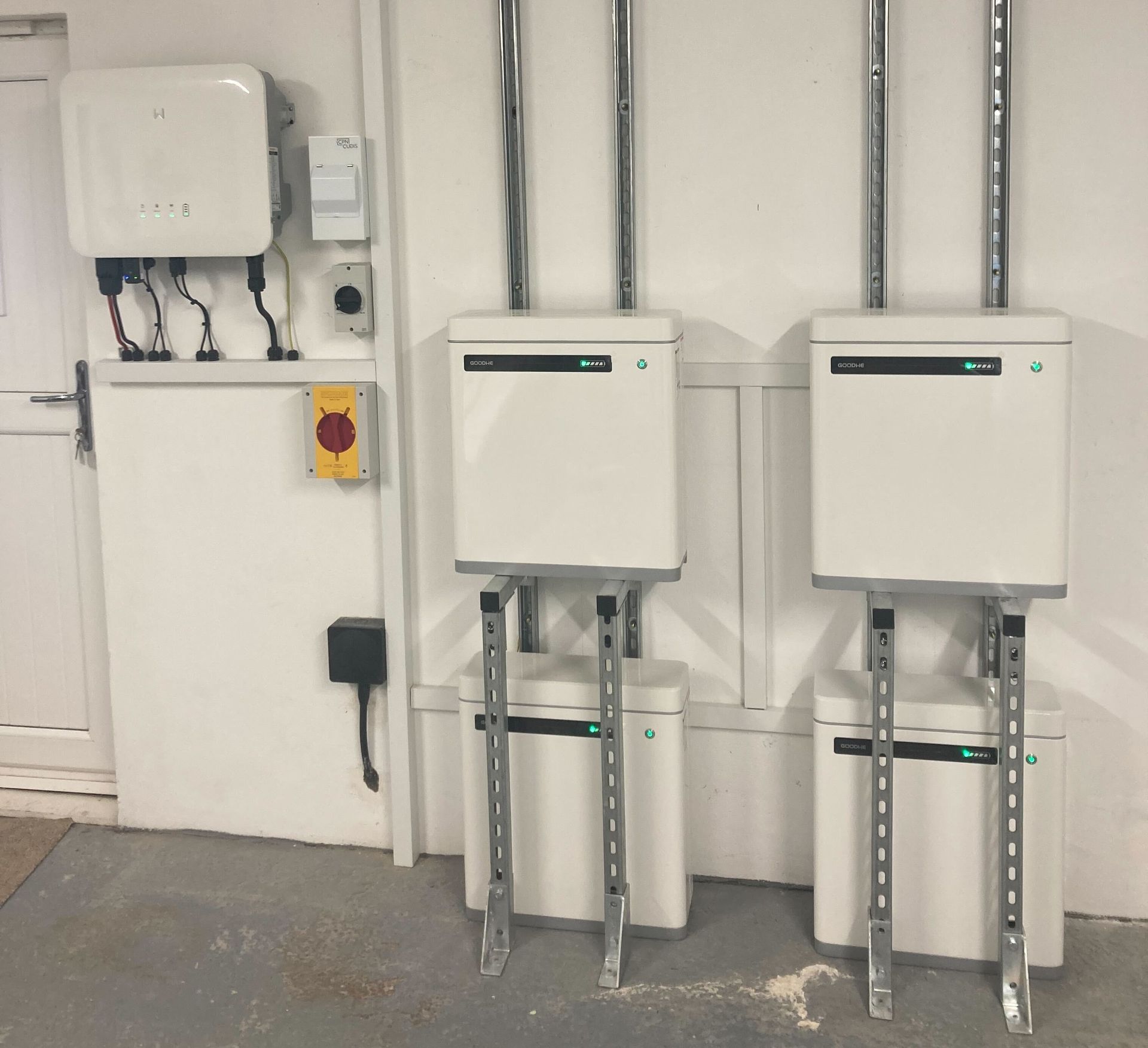
Battery storage, answered honestly.
Build the rest of the system.


Everything for homeowners
Heat pumps, grants and advice for your home in one place.
Explore homeowners
Ready to store your energy?
Get a free, no-obligation quote. We'll look at your usage patterns and your existing or planned solar, and design storage that fits — or tell you honestly if it doesn't yet.