Skip to Content
Solar PV

Solar power for your home — and your heat pump.

Generate your own electricity from your roof and put it straight to work: powering your appliances, your hot water and the heat pump that heats your home. We design and install solar PV alongside our heat pump systems, as a standalone installation, and at commercial scale.

MCS certified installer 20+ years' experience Design and installation in-house
Why solar

Electricity you generate is electricity you don't buy.

Every kilowatt-hour your roof produces is one you don't import from the grid — and the more of it you use yourself, the harder the system works for you.

Use your own power first

Your home draws on solar generation before it touches the grid. Homes with a heat pump, an electric vehicle or daytime occupancy use more of what they generate — which is where solar makes the biggest difference.

Get paid for what you export

Under the Smart Export Guarantee, energy suppliers pay you for every unit you send to the grid. Rates vary by supplier and you'll need a smart meter — we'll point you at the setup after installation.

Very little to look after

Solar panels have no moving parts and typically carry 25-year performance warranties. The inverter is usually the only component that needs replacing within the system's working life.

0% VAT until March 2027

Residential solar PV installations are currently zero-rated for VAT until 31 March 2027 — the price we quote is the price you pay, with no VAT added.

The pairing

Solar and a heat pump were made for each other.

A heat pump runs on electricity — so a roof that generates electricity feeds the heating system directly. While the sun is up, your heat pump and hot water can run on power you produced yourself.

Excess generation can be diverted automatically to heat your hot water cylinder, and adding a battery lets the heat pump keep drawing on solar after dark. We design the whole system — heat pump, panels, diverter and storage — as one, so each part is sized around the others.

Planning a heat pump as well? Get an estimate for your home, or explore battery storage for the evening half of the story.
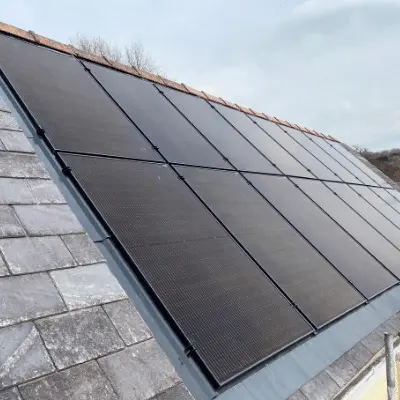
Solar PV panels integrated into a domestic roof
How it works

From daylight to your sockets in four steps.

Panels capture daylight

Photovoltaic cells convert daylight — not just direct sunshine — into DC electricity.

The inverter converts it

An inverter turns DC into the AC electricity your home runs on.

Your home uses it first

Appliances, hot water and your heat pump draw on solar power before importing from the grid.

Surplus exports or stores

Anything left over earns through the Smart Export Guarantee — or charges a battery for the evening.
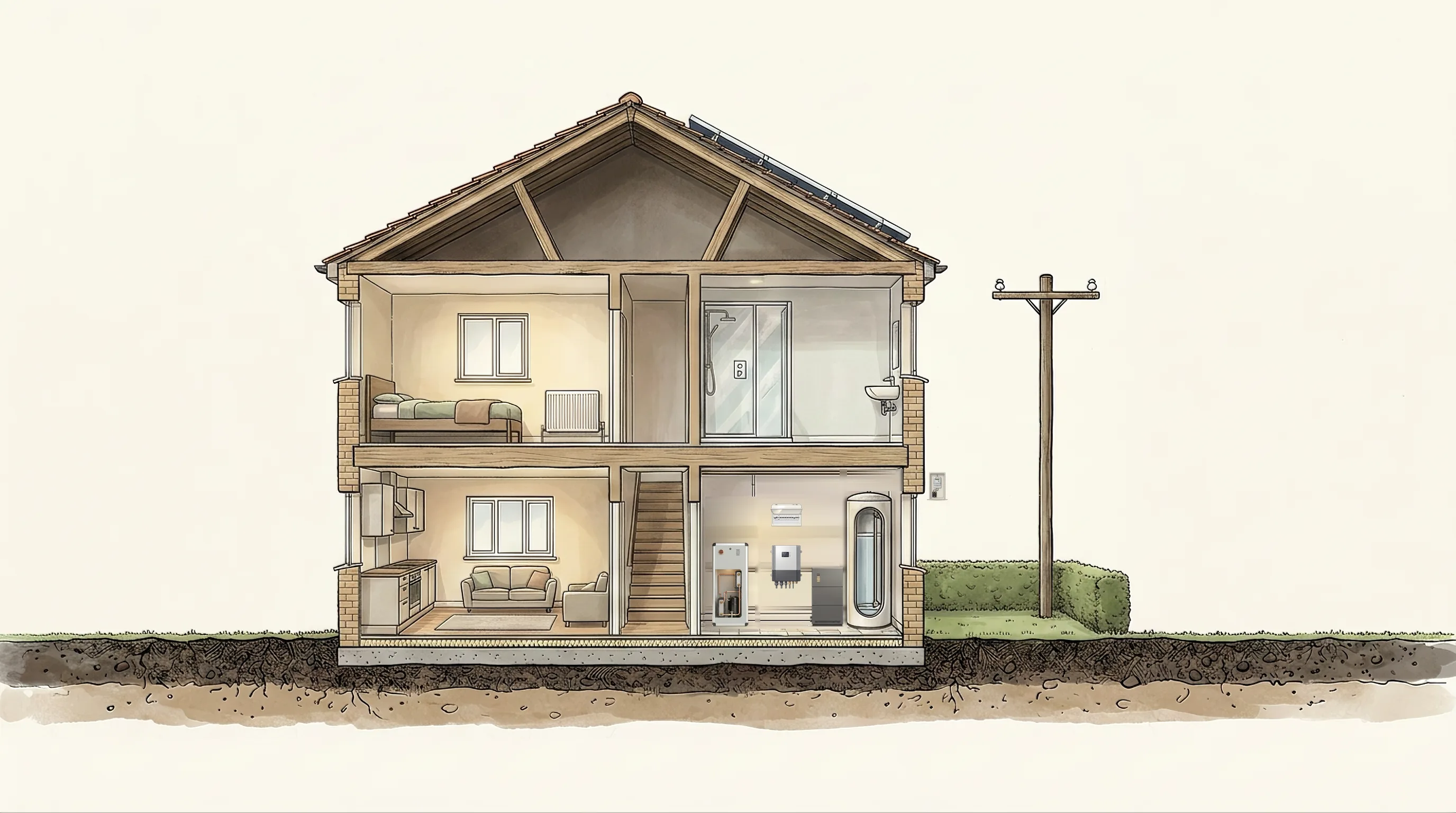
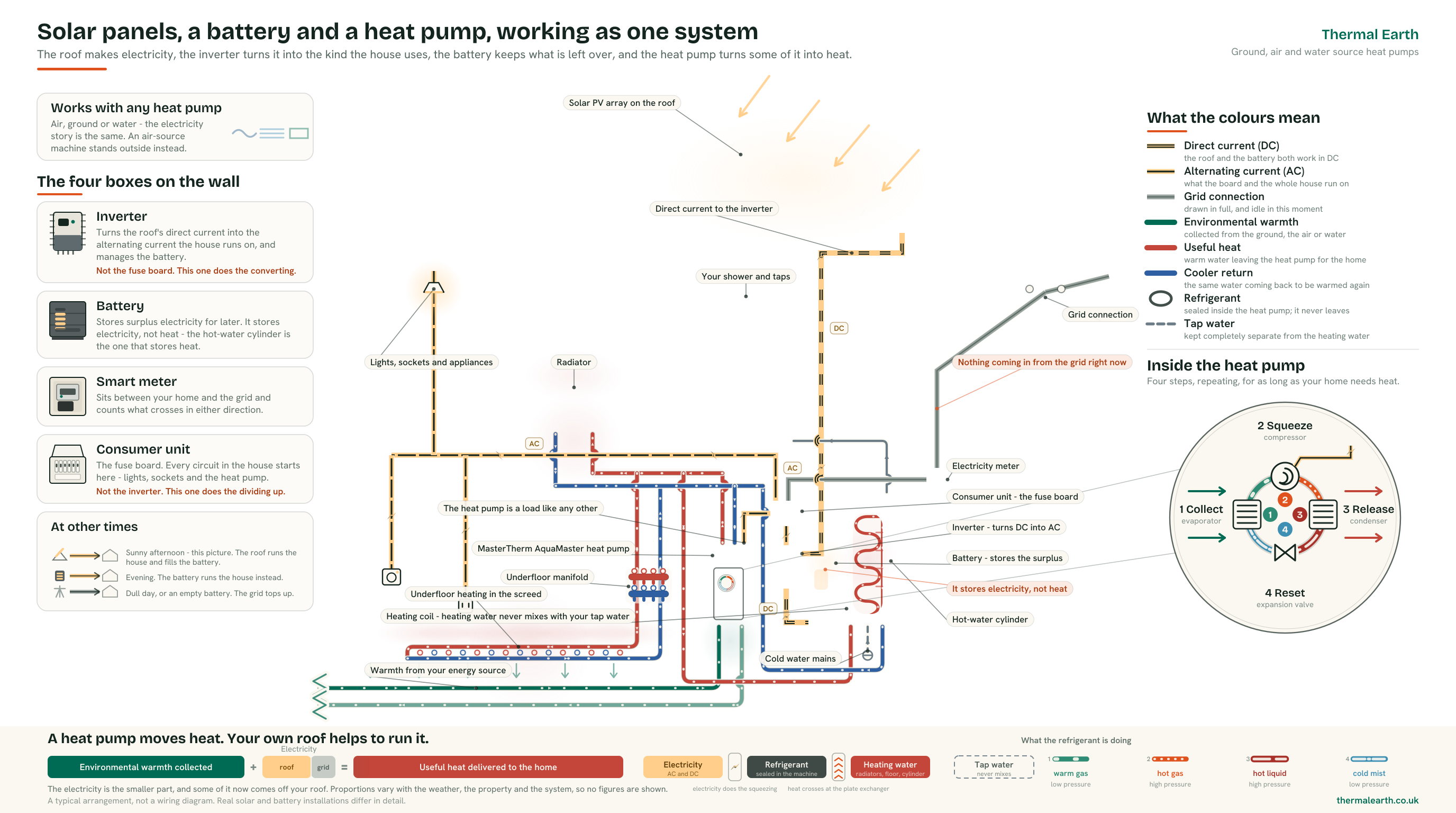
Flat cross-section of a two-storey UK home fitted with a rooftop solar photovoltaic array, a hybrid inverter, a battery, a smart meter, a consumer unit and an indoor heat pump. It shows one moment: a sunny afternoon, when the array is covering the whole house and the surplus is charging the battery. Direct current runs from the array through the loft and down to the inverter, which converts it to alternating current for the consumer unit; from there separate final circuits feed the household lights, sockets and appliances and, on its own circuit, the heat pump. The grid connection - a pole in the garden, an overhead service to the meter on the outside wall, and the meter tail through to the board - is drawn in full but is idle at this moment and shown in grey. The heat pump combines that electricity with environmental warmth collected from the ground, the air or water, and sends useful heat to underfloor heating, a first-floor radiator and the coil inside the hot-water cylinder. The refrigerant is sealed inside the machine and is shown both in its real service window and enlarged in a detail circle. The tap water is kept completely separate from the heating water.

Scroll the picture sideways to see all of it. Every label is written out below.

Solar panels, a battery and a heat pump, working as one system

What is in the picture

  • Environmental warmth collected from the ground, air or water Warmth from your energy source
  • Heating water: warm out to the home, cooler back Hot-water cylinder; MasterTherm AquaMaster heat pump; Heating coil - heating water never mixes with your tap water; Underfloor heating in the screed; Underfloor manifold; Radiator
  • Tap water, kept completely separate from the heating water Your shower and taps; Cold water mains
  • The grid connection, drawn but not running at this moment Electricity meter; Grid connection
  • Alternating current from the inverter to the board and the house Consumer unit - the fuse board; Lights, sockets and appliances; The heat pump is a load like any other
  • Direct current from the roof to the inverter and the battery Solar PV array on the roof; Direct current to the inverter; Inverter - turns DC into AC; Battery - stores the surplus
  • Refrigerant sealed inside the heat pump

The four steps inside the heat pump

  1. 1 Collect evaporator Environmental energy warms the refrigerant until it boils. It leaves as a warm gas at low pressure.
  2. 2 Squeeze compressor Electricity drives the compressor, squeezing that gas into a much smaller space. It leaves hot and at high pressure.
  3. 3 Release condenser The hot gas hands its heat to your heating water and condenses. It leaves as a hot liquid, still at high pressure.
  4. 4 Reset expansion valve A valve drops the pressure and the liquid flashes cold. It leaves as a cold mist, ready to collect more.
Designed for your roof

Sized from your roof and your usage, not from a table.

Most domestic systems fall between 3kW and 10kW, but what your roof will actually generate depends on its orientation, pitch, shading and location — so we calculate it for your home as part of the quote rather than promising a number from a brochure. East- and west-facing roofs remain viable, and can suit homes that use most power in mornings and evenings.

With a heat pump

Panels sized around your heating demand, with a hot water diverter and optional battery designed in from the start.

Standalone solar

No heat pump needed — we install solar PV on its own, designed around your electricity use and roof.

Commercial and larger sites

Larger arrays for businesses, farms and public buildings, delivered by the same in-house design and installation team.

Most domestic installations are permitted development and don't need planning permission — listed buildings and conservation areas are the usual exceptions, and we'll advise if yours is one.

Questions

Solar PV, answered honestly.

Yes — panels generate from daylight, not just direct sunshine, so they produce electricity on cloudy days at reduced output. Your design quote includes a generation calculation for your actual roof and location, so the numbers you see are yours rather than assumed.

South-facing roofs generate the most over a year, but east- and west-facing roofs remain worthwhile — and because they generate more in mornings or evenings, they can actually match household usage patterns better. North-facing roofs aren't recommended. We assess your roof and design the layout around it.

Most domestic solar installations are permitted development and don't need planning permission. The usual exceptions are listed buildings, conservation areas and panels that would protrude significantly from the roof. We'll tell you if your property needs approval and help with the application if it does.

Panels typically carry 25-year performance warranties and have no moving parts, so there is very little to go wrong. The inverter is the working component of the system and is normally the one part you'd expect to replace during the system's life.

A battery stores daytime generation for the evening, which matters most if you run a heat pump after dark. Whether it makes financial sense depends on your usage and tariff, so we'll advise honestly during the design rather than defaulting to yes. Read more about battery storage.
Keep exploring

More for your home.

Battery storage

Store what you generate in the day and use it after dark.

Explore battery storage

Everything for homeowners

Heat pumps, grants and advice for your home in one place.

Explore homeowners

Talk it through

Ask the team anything about solar, storage or pairing.

01269 833100

Ready to generate your own electricity?

Get a free, no-obligation quote. We'll assess your roof, calculate what it can generate and design a system around your home — solar on its own, or solar built around your heat pump.