Cooling and heat recovery for data centres.
A data centre rejects heat while its IT equipment operates. We assess heat-pump cooling and recovery around the measured load, useful heat demand and resilience requirements. Ground arrays are considered only where their long-term heat balance and capacity suit the duty.
Two duties, one coordinated system.
Cooling and heat reuse need to be assessed together. The design starts with the operating load and a reliable rejection route, then tests whether a useful heat demand is available.
Efficient cooling
Ground or water sources may contribute to cooling for suitable loads. Continuous heat rejection can warm a borefield, so capacity and seasonal heat balance must be modelled; additional heat rejection may be needed.
Waste-heat recovery
Heat pumps lift low-grade server heat to a usable 35–80°C for space heating, hot water or a nearby demand — energy the site would otherwise pay to throw away.
Resilience first
Recovery is only viable when the cooling duty is protected. We design an independent rejection route, so heat reuse never becomes a single point of failure.
From server load to useful heat.
Qualify the load
IT load, coolant or air temperatures, operating profile and the resilience the operation demands.
Protect the cooling
An independent heat-rejection route is designed first — recovery is an addition to the cooling system, never a dependency of it.
Lift the temperature
A heat pump raises captured low-grade heat to 35–80°C — usable for heating and hot water.
Serve a real demand
Recovered heat is matched to a demand nearby — offices, hot water or process pre-heat — with timing, distance and contracts assessed honestly.
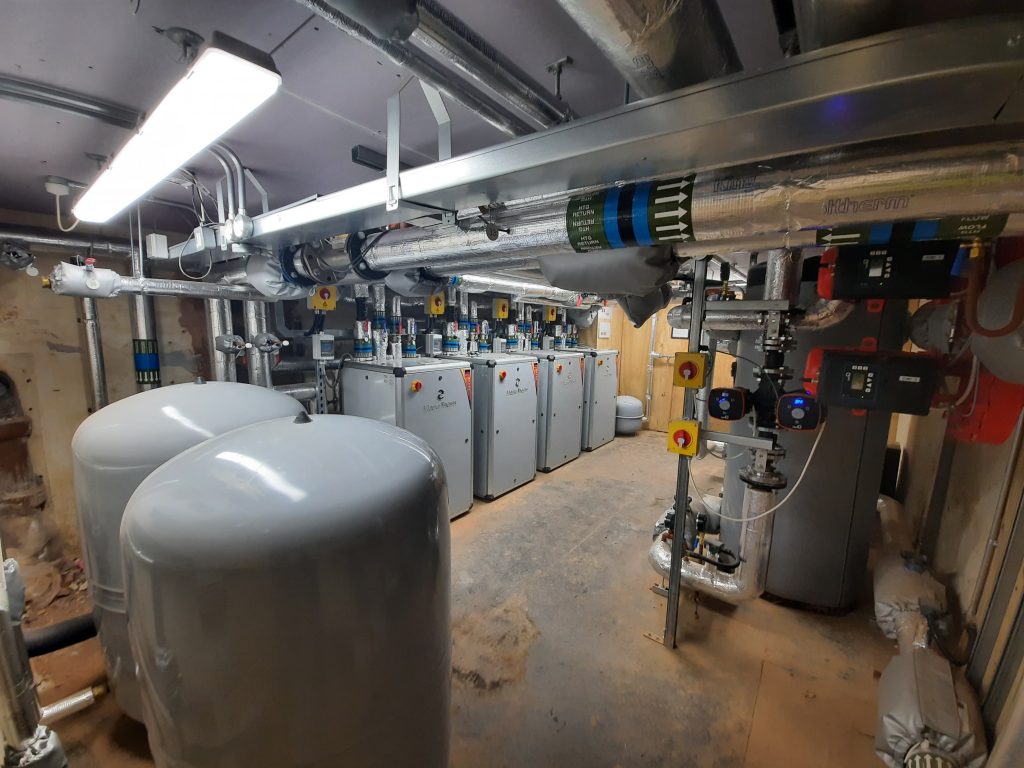
Commercial plant, engineered in-house.
MasterTherm units cascade to capacities beyond 1,000kW, with specialist AquaMaster recovery models handling source temperatures of 0–45°C — and remote monitoring through MasterTherm Online.
Design, installation and commissioning stay with one accountable team, from feasibility to the agreed maintenance schedule, with the scope confirmed for each project. Thermal Earth has traded since 2006.
Heat recovery
The full waste-heat capability — sources, equipment and viability.
Explore heat recoveryMine-water heat recovery
The Lindsay mine-water scheme, developed by the Mining Remediation Authority in partnership with Thermal Earth, with Innovate UK funding.
Explore mine-water recoveryTalk to us about your data centre.
Bring the IT load, the temperatures and the site. We'll tell you what cooling and recovery could look like — and what to measure next.